01.03.02
Genre as a Promise
Genre tells the audience how to feel about a doorway.
- Storytelling
- Cinematography
- Composition
What the Instructor can readThe Instructor reads your frames in the order you give them. It cannot assess movement, performance timing or sound from stills. This lesson's feedback rubric is new and has not been reviewed by an instructor yet.
The Idea
Genre is not the plot. It's the contract you sign in the first ten seconds.
A woman opens a mailbox. That is an event with no genre. Shoot it in flat noon sun, symmetrical, at her eye height, bright and saturated — the audience relaxes and waits for a joke. Shoot it from behind a hedge at night, low, off-centre, one hard streetlight and everything else black — the same woman is now in danger. Nothing about the event changed.
Genre lives in choices you already know how to make: light level and contrast, colour, camera height, distance, what's hidden, how much space is behind the character. Audiences read those cues faster than they read plot, and they read them whether or not you meant anything.
That is why genre is a promise. Set the cues and the audience starts expecting a kind of ending. Break the promise deliberately and you get irony, dread or comedy. Break it by accident and you get a film nobody knows how to watch.
Watch
Watch the scene, not the film. Ten minutes is enough — you're studying a decision.
Get Out
Jordan Peele · 2017
The suburban arrival, in daylight
Bright, warm, wide and friendly — horror cues withheld on purpose so the discomfort has to come from behaviour instead.
Parasite
Bong Joon-ho · 2019
The descent through the city in the rain
The film changes genre by changing light, level and weather while the family stays exactly who they were.
Fargo
Joel & Ethan Coen · 1996
Wide white exteriors around small figures
Comedy and menace held in one frame: the flat overcast light refuses to tell you which one to feel.
Alien
Ridley Scott · 1979
Corridors before anything happens
The promise is made entirely by negative space, darkness and what the frame declines to show.
Break It Down
One event — someone opens a mailbox — staged twice. Compare the cue lists, not the stories.
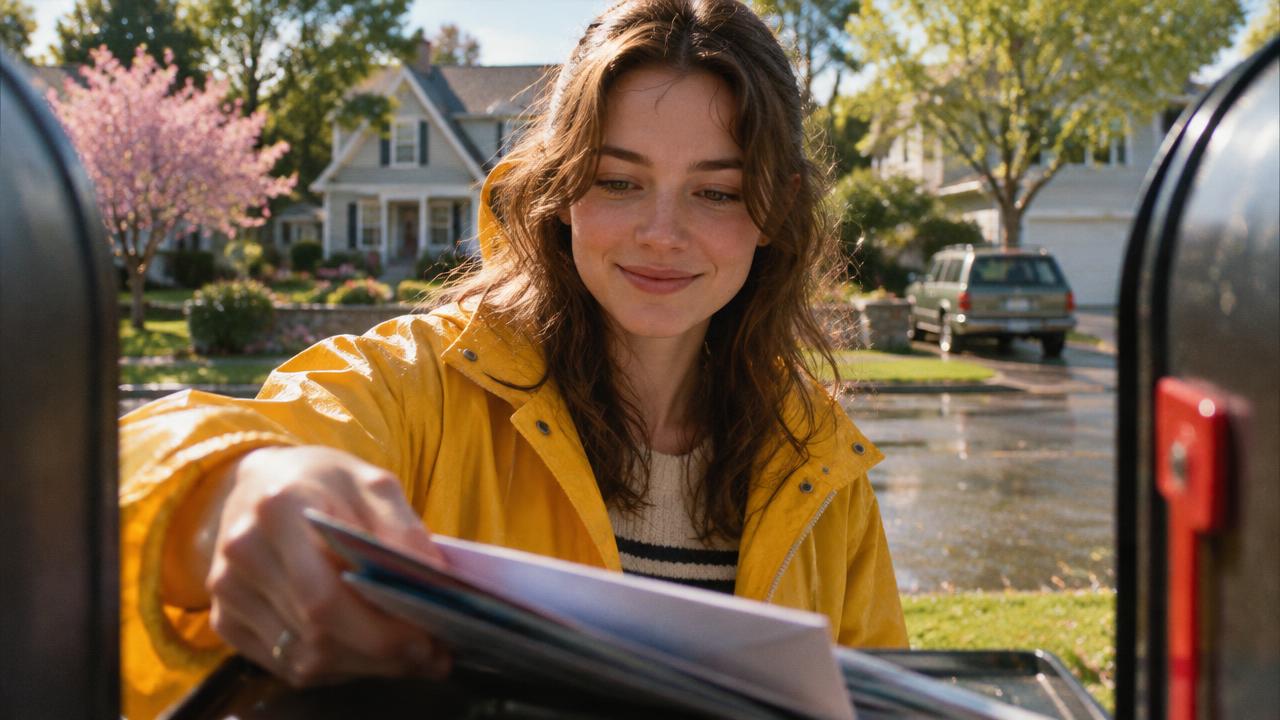
Frame 1 — original FILMCRAFT study frame, shot for this lesson. Frame 1
Version A — comedy cues
Midday sun, high key, saturated yellow, subject centred at her own eye height, deep space behind her full of tidy houses. Nothing is hidden, so there is nowhere for threat to live.
- What the audience learns
- This will be light. Expect a joke or a small embarrassment.
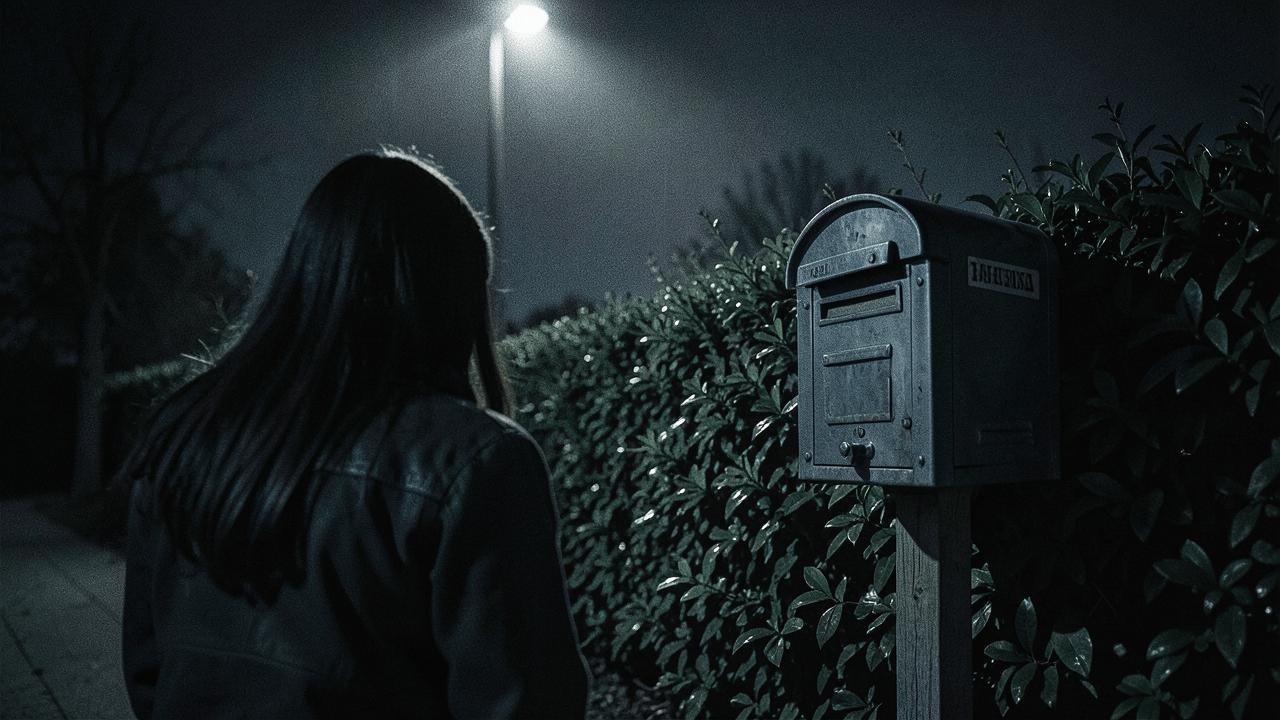
Frame 2 — original FILMCRAFT study frame, shot for this lesson. Frame 2
Version B — thriller cues
Night, single hard source, desaturated cold cast, camera low and behind foliage so the viewer is concealed, subject turned away and off-centre with black space beside her. The hedge in the foreground makes you a watcher.
- What the audience learns
- Someone is watching her. Expect harm.
Frame 3
The cue list
Light level and contrast; colour temperature and saturation; camera height; concealment in the foreground; how much dark space surrounds the subject; whether the face is given. Six variables, no plot.
Frame 4
What a beginner would do
Write 'HORROR' in the title, add a red tint and a scary font, and change none of the six. Labels are not cues — the audience believes what the frame does.
Frame Lab
Visual mission
Find four frames from four genres and list the visual cues that make the promise.
Name light level, colour, camera height, concealment and space. If your reason is 'it feels scary', you haven't found the cue yet.
FILMCRAFT stores your observations and source links — never other people's images.
Try It
Same Event, Two Promises
30 minutesPick one boring event you can stage in two minutes. Photograph it twice, once with the visual cues of one genre and once with another. Submit two ordered frames and name the intended genre at the start of each frame's note.
Exactly 3 frames.
Constraints
- Same event, same subject, same location
- Change light, height, distance, colour or concealment — not the action
- Begin each frame note with the intended genre
- No captions or titles inside the images
- An ordinary object — a box or a cup is enough
- No threatening behaviour or dangerous props
Deliverable
Two ordered stills, each noted with its intended genre.
Make It
Two Versions, Four Frames
90 minutesStage the same simple event twice in two different genres, two frames per version. Submit exactly four ordered frames: frames 1–2 are Version A, frames 3–4 are Version B. Begin each frame's note with the genre name so the grouping is readable. You are critiqued on whether the frames carry the genre — naming it does not count.
Exactly 6 frames.
Frames 1–3: Version A · Frames 4–6: Version B
Constraints
- Exactly four ordered frames: 1–2 Version A, 3–4 Version B
- Start every frame note with the genre name, e.g. "Comedy — ..."
- The event, subject and location stay the same across both versions
- No titles, captions, fonts or on-screen text doing the work
- Same event, two expectations
- Any sound or timing idea is described as an untested plan
Deliverable
Four ordered stills in two labelled pairs, plus a note per frame naming its genre and its cues.
AI Lab
The traditional workflow
You learn genre by watching openings with the sound off and writing down what the light is promising.
What AI changes
Genre is the thing image models are best at, because it is convention. Ask for 'horror' and you'll get fog, cyan and a low angle instantly. That fluency is useful for testing cues and dangerous for finding your own: the model gives you the average of every horror film, which is exactly what nobody remembers.
Try it
Generate your event in three genres, changing only the genre word in your prompt. List which visual variables the model changed each time.
Compare
Then shoot one of them yourself and find the cue the model missed — usually something specific to your actual location: a real lamp, a real wall, a real time of night.
Ethics check
Genre cues carry stereotypes. Ask who a look makes dangerous, and whether that is a choice you meant to make. Generated crowds and faces inherit the training set's assumptions, so do not use them as evidence of what a place or person looks like.
Sign in to sketch reference frames for this lesson.
- bookFilm/GenreGenre as an agreement between industry, film and audience rather than a fixed list.
- bookPainting with LightWhere most thriller lighting cues came from in the first place.
Reflect
Go Deeper
film
Parasite
Bong Joon-ho · 2019
Track the exact scene where the genre changes, and list what changed visually.
film
Get Out
Jordan Peele · 2017
A horror film that withholds horror cues for forty minutes. Notice what it uses instead.