01.02.03
Depth & Layers
A flat frame shows you a place. A layered frame puts you inside it.
- Composition
- Cinematography
The Idea
Three planes turn a picture into a world.
A camera flattens everything it sees. Depth is not something a location gives you — it is something you stage. You get it by putting distinct things at distinct distances: something near the lens, your subject in the middle, and a background that is its own space rather than a wall standing behind everyone.
Layers do work no dialogue can do. A foreground you look past makes the viewer a watcher: hidden, uninvited, complicit. A deep background tells us where this person is small. An empty middle plane isolates. Overlap — one thing crossing in front of another — is the single clearest signal a brain reads as depth, and it costs nothing.
Separation is the discipline. Three planes only read as three if they differ: in tone, in sharpness, in texture, in colour. Stack three grey things at three distances and you have made one grey thing. Most flat frames are not missing layers; they are missing contrast between them.
Watch
Watch the scene, not the film. Ten minutes is enough — you're studying a decision.
Citizen Kane
Orson Welles · 1941
Young Charles sledding through the window while his future is signed away
Three planes, all in focus, all in conflict. The frame argues with itself instead of cutting.
The Godfather
Francis Ford Coppola · 1972
The wedding seen from inside Vito's dark study
The bright garden sits behind a shadowed foreground. You are placed on the inside of the family, looking out.
Children of Men
Alfonso Cuarón · 2006
The road ambush, action crossing every plane
Foreground, middle and far distance all carry story at once, so the long take never runs out of information.
Rear Window
Alfred Hitchcock · 1954
Watching the courtyard apartments from the chair
The frame within the frame makes distance the whole subject: near safety, far consequence.
Break It Down
Look for the planes before you look for the story. Then notice how the planes make the story.
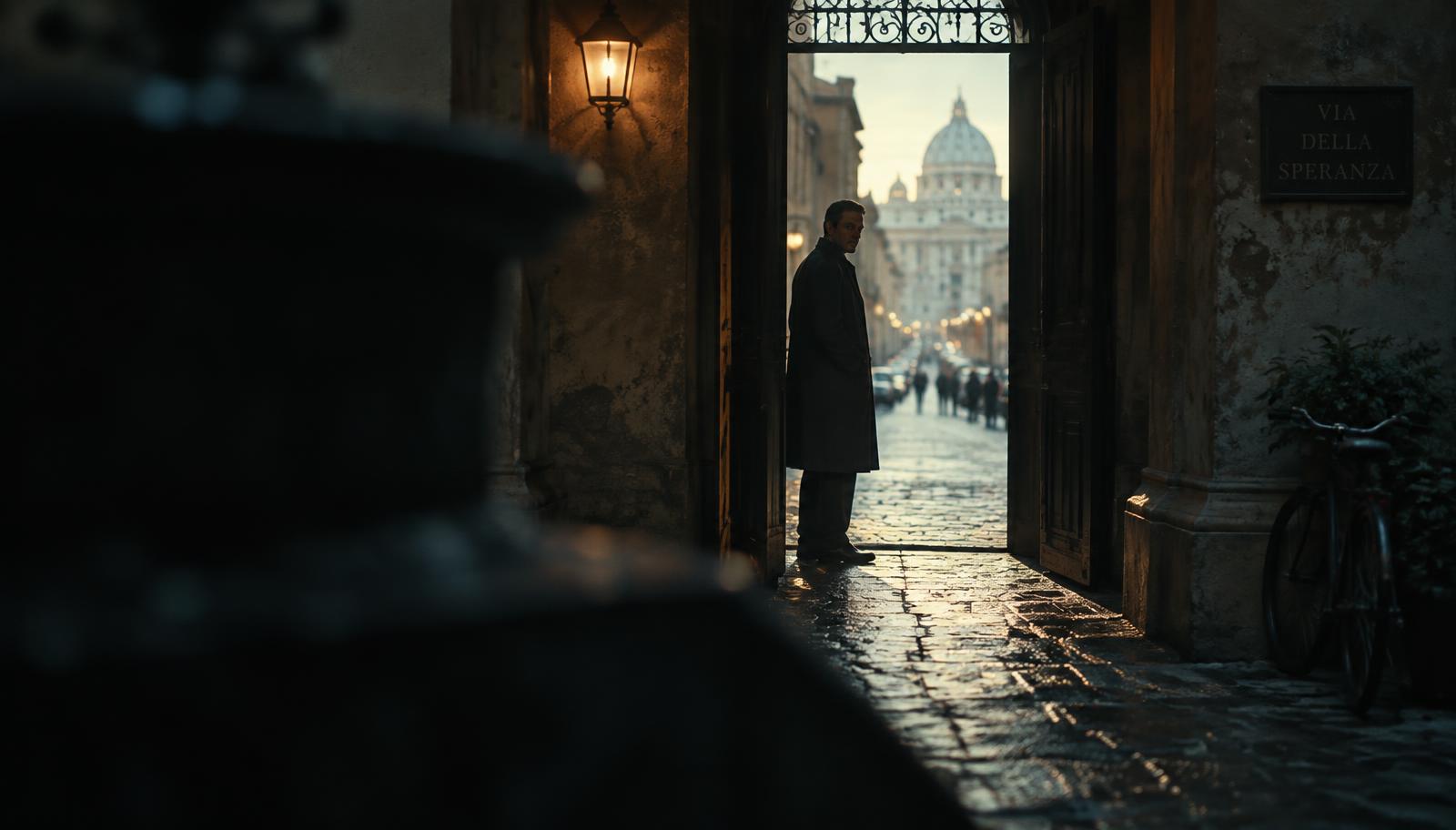
- 01
Near
A dark shape crosses the bottom-left corner. It is unreadable and out of focus, which is exactly its job: it gives the eye something to look past.
- 02
Middle
The figure sits at the only sharp distance in the frame, so attention lands there without any brightness trick.
- 03
Far
The space behind the doorway continues rather than stopping. The world does not end at the subject's back.
- 04
Separation
Each plane sits at a different brightness — dark, mid, bright. That difference, not the distance itself, is what makes the depth legible.
- 05
What a beginner would do
Step around the foreground object to get a clean view — and trade the feeling of watching for a clear, ordinary picture.
Frame Lab
Visual mission
Find five frames where the foreground changes who the viewer is.
Ask each time: am I in the room, invited in, or hiding? The foreground usually decides.
FILMCRAFT stores your observations and source links — never other people's images.
Try It
Three Planes
20 minutesShoot one original still that clearly holds three planes: something near the lens, your subject in the middle, and a background that is its own space. Move your body, not the zoom.
Exactly 1 still.
Constraints
- Something real in the foreground — a doorway, leaves, a shoulder, a railing
- Your subject in the middle, and a background that is its own space
- The three planes must differ in brightness or sharpness, not only in distance
Deliverable
One still, with a sentence naming what each plane is doing.
Make It
The Reveal
60 minutesMake two frames of the same subject from the same distance. In the first, the foreground hides most of them. In the second, the foreground opens and lets them through. Change only the foreground.
Exactly 2 frames.
Constraints
- Identical camera position and subject placement in both
- No change to lighting or lens
- Write which version makes the viewer an intruder, and why
Deliverable
Two stills submitted as an ordered pair, plus your note on what changed emotionally.
AI Lab
The traditional workflow
You scout with your feet: walk a location, crouch, look through doorways and around obstacles until a foreground appears that you can shoot past.
What AI changes
Image models will happily invent a layered frame, and vision models can help you check whether your own frame actually separates its planes. Neither can tell you what your foreground should mean.
Try it
Describe your Three Planes still in words — near, middle, far, and the tonal difference between them — precisely enough for an image model to rebuild it. Generate two variations, then go back and shoot one of them for real.
Compare
Set the generated frame beside your photograph. Models tend to over-produce foregrounds. Note one layer the model added that earns its place, and one it added purely for decoration.
Ethics check
Generated frames are planning material. Disclose them if they appear in published work, and never use a generated likeness of a real person without consent.
Sign in to sketch reference frames for this lesson.
- bookThe Visual StoryThe chapter on depth cues — overlap, size, tone, perspective — is the practical reference here.reviewed 2026-09-01
Reflect
Go Deeper
film
Citizen Kane
Orson Welles · 1941
Watch only for what is happening behind the person speaking.
film
Children of Men
Alfonso Cuarón · 2006
Track how information is distributed across planes so the long takes stay legible.