01.02.04
Eyelines & Blocking
Power is where people stand and who looks first.
- Directing
- Composition
The Idea
Two bodies in a room are already a scene.
Before a word is spoken, an audience is usually already forming a view about who has the upper hand. They tend to read it from four things you control: how far apart the two people are, how high each one sits in the frame, which way their bodies are turned, and whose eyes go first. Blocking is not choreography. It is an argument the frame is making about a relationship.
An eyeline is a line the audience draws for themselves. When one person looks and the other does not look back, the frame often tells us who wants something. When both look away, it can read as a conversation that has already failed — though context and performance can pull it elsewhere. Withholding a look can be as strong a choice as giving one, as long as you chose it.
Screen geography is the quiet discipline underneath all of it. A viewer usually needs to be able to place both people in the room without effort. Keep each person on their own side of the frame, keep the space between them visible, and any change you then make — a step closer, a turn away, a swap of sides — is more likely to land as meaning rather than confusion.
Watch
Watch the scene, not the film. Ten minutes is enough — you're studying a decision.
There Will Be Blood
Paul Thomas Anderson · 2007
The baptism, and the final bowling-alley confrontation
Height and kneeling do the whole power reversal. Watch who is above whom in every beat.
The Social Network
David Fincher · 2010
The opening bar conversation
Two people at one small table, and the eyelines keep missing. The staging is the breakup.
In the Mood for Love
Wong Kar-wai · 2000
The corridor and stairwell passings
Distance held for the whole film. Nearness is rationed, and each small change reads enormous.
Hunger
Steve McQueen · 2008
The long static table conversation
One fixed arrangement, no coverage. Everything is carried by where the two men sit and where they look.
Break It Down
Read the arrangement before you read the faces. The arrangement was decided first.
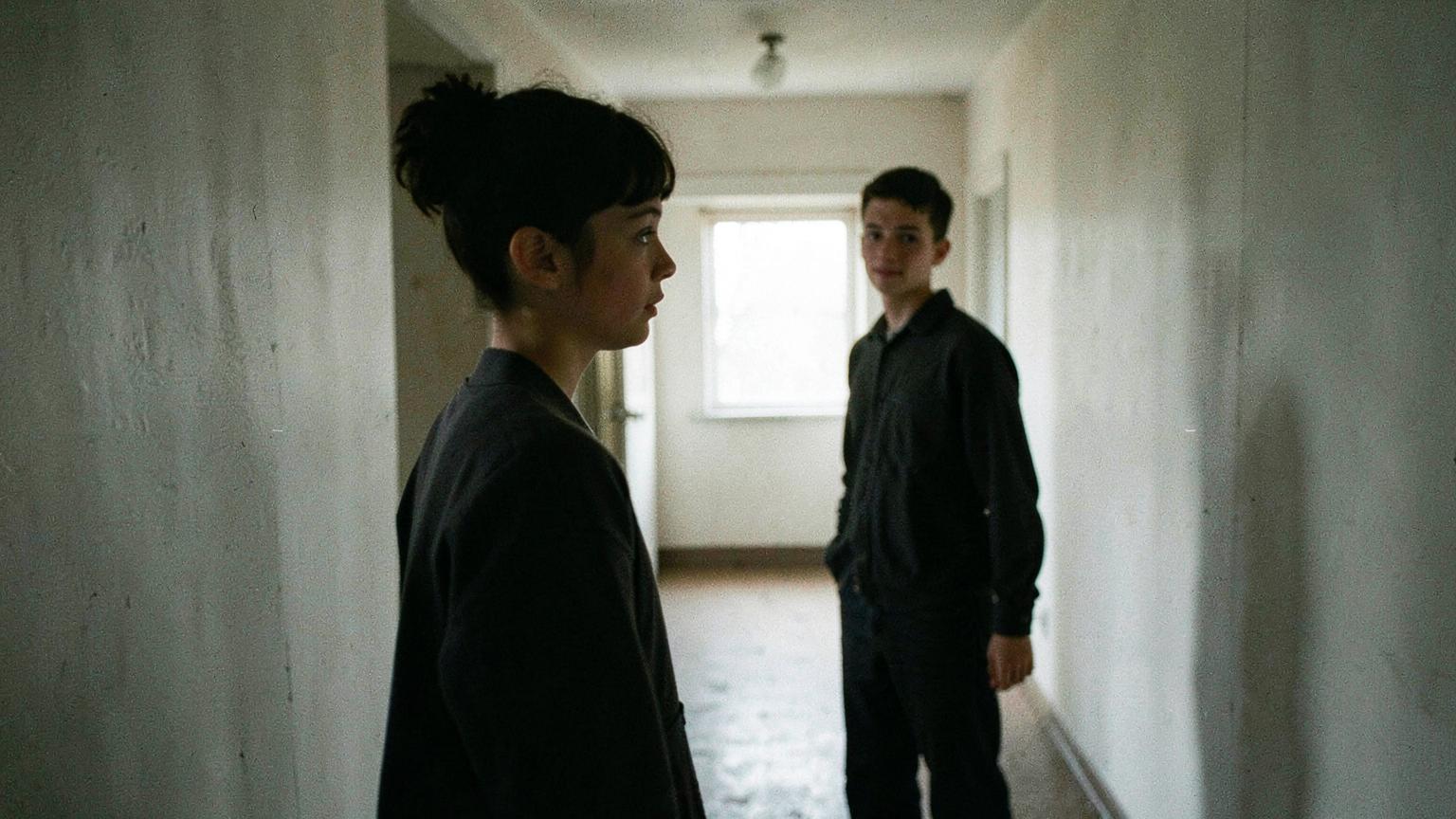
- 01
Distance
The gap between them is left visible and empty. The frame does not let them share a comfortable closeness, so the space itself becomes the subject.
- 02
Who looks
The further figure faces the nearer one directly. The nearer one is held in profile, so we cannot confirm the look is returned.
- 03
Height and scale
The nearer figure is larger simply because they are closer. Size here is a position, not a fact about either person.
- 04
Screen geography
One person holds the left of the frame, the other the right, with the corridor lines running between them. A viewer can place both without effort.
- 05
What a beginner would do
Bring them side by side, both facing the lens, so both faces are clear — and lose the relationship entirely.
Frame Lab
Visual mission
Find five frames where you know the relationship before anyone speaks.
For each: how far apart, who is higher, who is turned away, and who looks first.
FILMCRAFT stores your observations and source links — never other people's images.
Try It
Two People, One Truth
25 minutesShoot one original still of two figures in the same space where the arrangement alone says what they are to each other. Decide who looks and who does not before you press the shutter.
Exactly 1 still.
Constraints
- Decide before shooting who looks and who does not
- Put them at different distances or different heights — not side by side
- No captions, no props explaining the relationship
- Working alone is fine: a reflection, a shadow, a photograph or an empty chair can be the second figure
Deliverable
One still, plus a sentence naming what you wanted a stranger to believe.
Make It
The Turn
75 minutesMake an ordered set of 3 to 6 frames in one location where the relationship between two figures reverses. Nobody speaks. Only where they stand and who looks changes. Submit the frames in the order they should be read.
Between 3 and 6 frames.
Constraints
- One location, the same two figures throughout
- The reversal must be visible in the staging, not explained in your notes
- Keep screen geography readable — do not swap sides unless the swap is the point
- Order matters: the sequence you submit is the sequence FILMCRAFT reads
Deliverable
An ordered set of 3–6 stills, plus one line on what turns the power.
AI Lab
The traditional workflow
You block a scene on your feet with the actual people in the actual room, walking it until the arrangement says what the scene means.
What AI changes
Image models can sketch staging options quickly, and are useful for asking 'what would this look like if she were higher than him?' before you get to the location. They are unreliable about eyelines and physical space: generated figures often look at nothing, and generated rooms rarely obey their own geometry.
Try it
Describe your Turn sequence as three staging arrangements in words. Generate each. Then note every place the model got the eyeline or the spatial relationship wrong — that list is a better lesson than the images.
Compare
Set a generated arrangement beside your photographed one. Ask which one a viewer could draw a floor plan from. Usually the real one.
Ethics check
Never generate a likeness of a real person you know without their consent, and never use generated people to stand in for a performance you then credit as directed.
Sign in to sketch reference frames for this lesson.
- bookFilm Directing: Shot by ShotThe standard practical reference for staging, screen geography and the line of action.reviewed 2026-09-01
Reflect
Go Deeper
film
There Will Be Blood
Paul Thomas Anderson · 2007
Watch only for who is standing and who is kneeling.
film
In the Mood for Love
Wong Kar-wai · 2000
Track the distance between the two leads scene by scene. It is a graph of the film.