01.02.02
Negative Space
The empty part of the frame is not empty. It is the loudest thing you own.
- Composition
- Cinematography
- Storytelling
The Idea
Emptiness is a character you can cast.
Negative space is everything in the frame that isn't your subject: wall, sky, table, road, blur, dark. Beginners treat it as waste and zoom in until the subject fills the frame. Filmmakers treat it as material.
Space does three jobs. It sets scale — a person small in a wide frame is a person who can be overwhelmed. It sets pressure — space in front of a face feels like possibility, space behind it feels like something following. And it sets waiting — an empty area a character could move into, or something could enter, makes the audience lean forward without a single cut.
The technical part is easy. The hard part is deciding what the emptiness means in this story, in this moment, for this character — and then having the nerve to leave it there.
Watch
Watch the scene, not the film. Ten minutes is enough — you're studying a decision.
Lost in Translation
Sofia Coppola · 2003
The hotel window, Tokyo at dusk
A wide frame keeps her small against glass and city. The loneliness is compositional, not spoken.
Tokyo Story
Yasujirō Ozu · 1953
The rooms people have just left
Ozu holds on the space after the exit. The absence becomes the subject.
The Conversation
Francis Ford Coppola · 1974
Harry alone in the gutted apartment
Empty floor swallows a man who spends the film listening. Space as paranoia.
Hereditary
Ari Aster · 2018
Static wides of the house at night
Dark corners are left deliberately available. You search them because the frame invited you to.
Break It Down
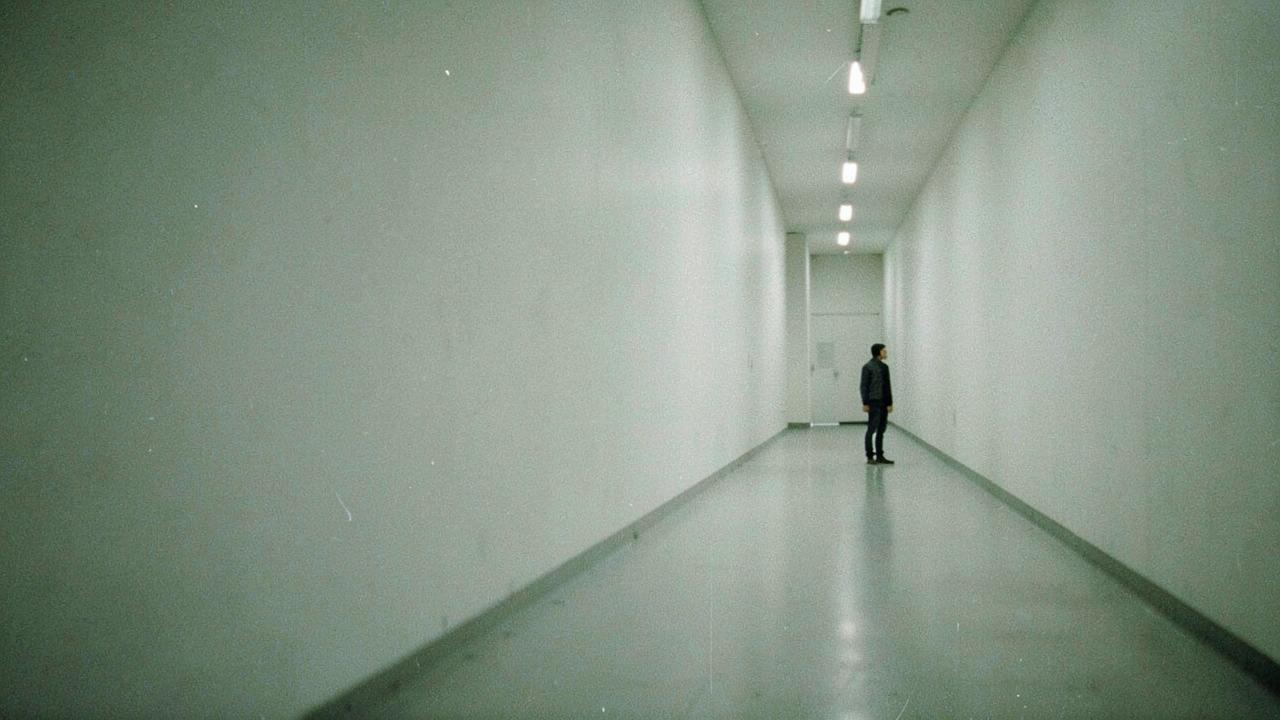
Take one frame slowly. Don't describe what happens — describe what the filmmaker decided.
- 01
Ratio
The figure occupies roughly 4% of the frame. Nothing competes with them, and nothing supports them either.
- 02
Placement
They sit at the far end of a receding perspective, so the emptiness reads as distance the viewer has to travel — not just wall.
- 03
Direction of space
The space is behind and around, not in front. There's nowhere to walk toward. The composition closes the future off.
- 04
Tone
Flat overhead light keeps the walls featureless. Texture would have given the eye company; the choice to remove it is the emotion.
- 05
What a beginner would do
Push in until the face is legible — and lose the entire meaning of the shot in exchange for information nobody needed.
Frame Lab
Visual mission
Find five frames where negative space communicates loneliness.
Vary the source: one comedy, one horror, one documentary. Loneliness is not only a drama tool.
FILMCRAFT stores your observations and source links — never other people's images.
Try It
The 80% Frame
20 minutesShoot one original still where your subject occupies no more than 20% of the frame, and the emptiness carries the feeling. Shoot as many exploratory versions as you like — you hand in the single frame you choose.
Exactly 1 still.
Constraints
- Phone camera only, no cropping afterward
- Move the camera, not the subject
- Shooting five exploratory versions first is good practice — it is not part of what you hand in
Deliverable
One still, plus a sentence on what the emptiness is doing.
Make It
Room for One
90 minutesMake three ordered stills of the same subject in the same location, telling one small story of waiting for someone who never arrives. Only the amount and shape of the empty space changes. Submit them in the order they should be read.
Exactly 3 frames.
Constraints
- No dialogue, no captions
- Same subject, same location, same lens distance
- The empty space must change meaning at least once across the three
Deliverable
Three ordered stills, plus a line on what the emptiness does in each.
AI Lab
The traditional workflow
You build a look book by hand: pull frames from films you love, photograph your location, sketch the blocking, and shoot tests until the geometry is right.
What AI changes
Image models let you rough out compositional ideas in minutes — twenty variations of a figure placed in an empty room — and vision models can measure things for you, like the percentage of frame a subject occupies across your own footage. Neither one has an opinion about your story.
Try it
Take your best 'Try It' still. Describe its composition in words precisely enough for an image model to generate a variation. Generate three. Then shoot one of those three yourself.
Compare
Put the generated variation beside your photographed one. Which choices did the model make that you wouldn't have? Which of your choices survived contact with a real location, real light and a real person? Write down one thing the model got right and one thing it flattened.
Ethics check
A generated look-book frame is a private planning tool, not a deliverable. If any generated image appears in work you publish, disclose it. Never generate imagery that imitates a living person's likeness without consent, and don't present a prompt as a photograph you took.
Sign in to sketch reference frames for this lesson.
- websiteC2PA — Content CredentialsThe emerging standard for attaching provenance to media. Useful vocabulary for disclosure.reviewed 2026-08-01
- ai-toolText-to-image previsualization (category, not product)Any current image model works for composition roughs. Judge on control — reference images, aspect ratio, region editing — not on realism.reviewed 2026-08-01
Reflect
Go Deeper
film
Tokyo Story
Yasujirō Ozu · 1953
Watch the shots that begin before anyone enters and end after everyone leaves.
book
The Visual Story
Bruce Block
The clearest existing account of space, contrast and affinity as controllable variables.
interview
Christopher Doyle on framing instinct
Various
Useful counterweight: a cinematographer arguing against over-planning the frame.
stillslab mission
Negative space study set
Deep-link placeholder — external stills reference for this lesson's Frame Lab mission.