01.01.03
Point of View
Whose film is this, shot by shot?
- Directing
- Storytelling
- Composition
What the Instructor can readThe Instructor reads your frames in the order you give them. It cannot assess movement, performance timing or sound from stills. This lesson's feedback rubric is new and has not been reviewed by an instructor yet.
The Idea
Every frame answers a question nobody asked out loud: whose side are we on?
Point of view in film is not who narrates. It is where the camera stands and who it keeps choosing. Objective framing watches people from outside, fairly, like a witness. Subjective framing moves inside somebody — their height, their distance, their view, their blind spots.
You do not need a literal 'what she sees' shot to make a film subjective. Standing closer to one character than the other, staying with one person after the other leaves, cutting to a reaction instead of an action — all of these quietly hand the audience to somebody.
The skill is choosing, and then keeping the choice long enough that breaking it means something. A film that drifts between everyone's view usually belongs to nobody.
Watch
Watch the scene, not the film. Ten minutes is enough — you're studying a decision.
Rear Window
Alfred Hitchcock · 1954
Looking across the courtyard, then back to his face
The strictest POV structure in popular cinema: we are allowed to know only what he can see from one chair.
Son of Saul
László Nemes · 2015
The camera locked to one man's face and shoulders
Subjectivity by exclusion — the horror stays out of focus behind him because his attention is elsewhere.
Moonlight
Barry Jenkins · 2016
The schoolyard, and the close portraits facing the lens
The film hands itself to Chiron by distance and eyeline. You are not watching him; you are beside him.
Break It Down
The same encounter, framed two ways. Nothing about the event changes. Only who the frame belongs to.
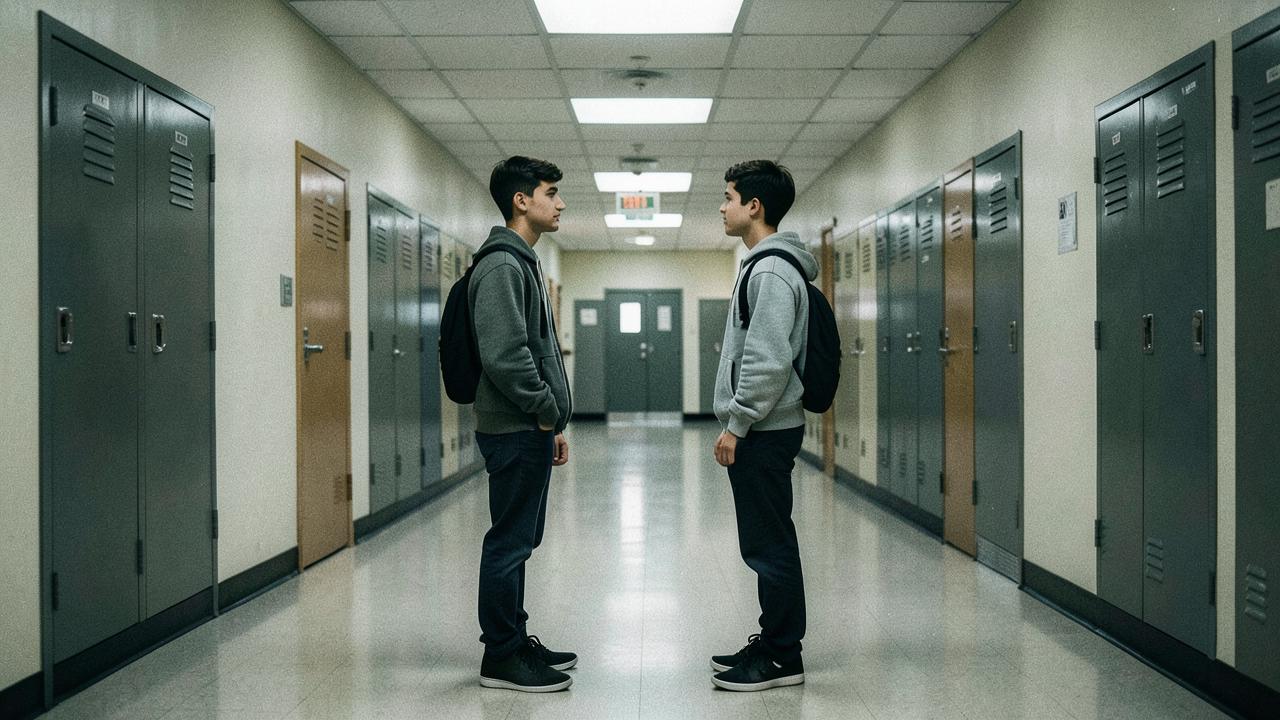
Frame 1 — original FILMCRAFT study frame, shot for this lesson. Frame 1
Objective — the witness
Both bodies in profile, equal size, equal space, camera at chest height between them. The frame refuses to take a side; you judge them both from outside.
- What the audience learns
- This is a situation. You are allowed to assess it.
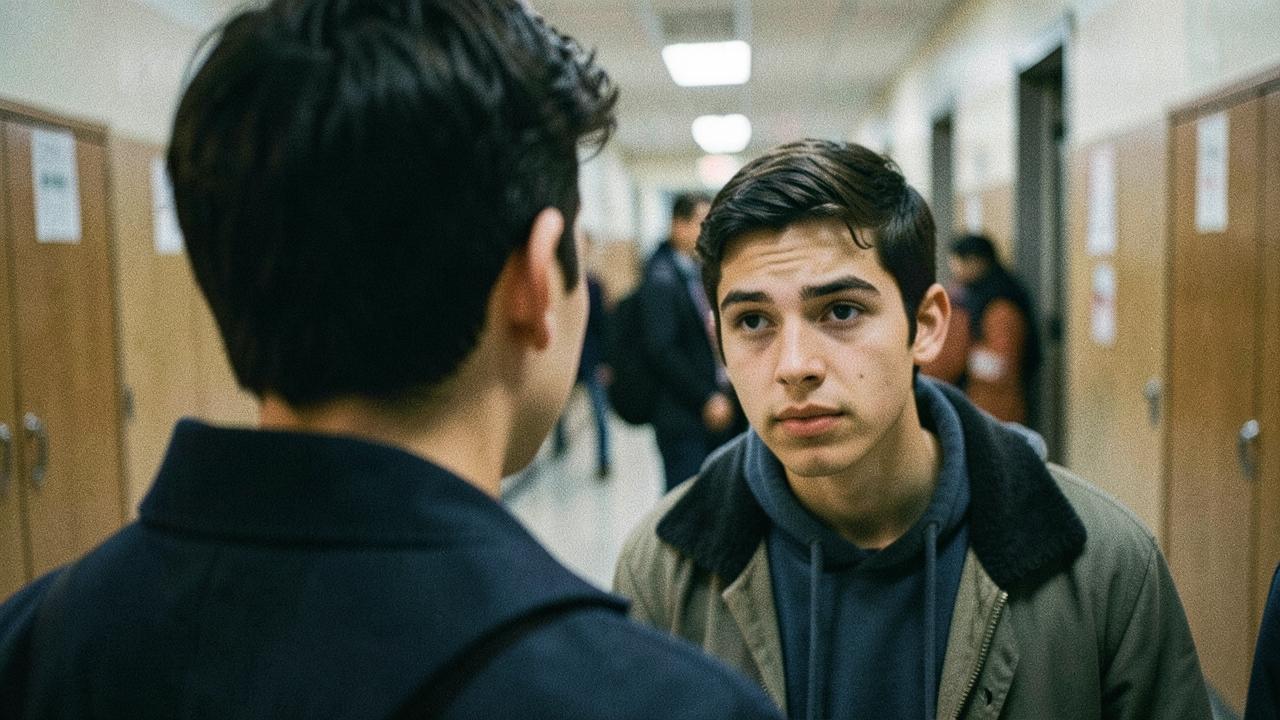
Frame 2 — original FILMCRAFT study frame, shot for this lesson. Frame 2
Subjective — the participant
Now the camera sits at one character's shoulder. The other is close, sharp and nearly looking down the lens; the first is a blurred mass at the edge. You are not watching the conversation — you are in it, from one side.
- What the audience learns
- This is my encounter, and I am the one being looked at.
Frame 3
What carries the shift
Three things and none of them are dialogue: the camera's height moved to one person's eyes, the distance collapsed for one face only, and the other face lost focus. Subjectivity is mostly a decision about who gets to be sharp.
Frame 4
What a beginner would do
Shoot a literal eyeline point-of-view shot — the hallway as she sees it, hands entering frame — and stop there. The literal version is the weakest tool in the set; proximity and attention do more.
Frame Lab
Visual mission
Find four frames and name whose film each one belongs to, and how you know.
Evidence only: camera height, distance to each face, who is in focus, who is cut off by the frame.
FILMCRAFT stores your observations and source links — never other people's images.
Try It
Witness, Then Participant
25 minutesPhotograph the same small moment twice: first objectively, from outside, treating both sides fairly; then subjectively, from one side's height and distance. Submit the pair in that order.
Exactly 3 frames.
Constraints
- Same moment, same location, same light
- The objective frame must not favour either side
- The subjective frame must change height or distance, not just angle
- Approach, discovery, response
- Declare whether the viewer knows more, less or the same as the character
Deliverable
Two ordered stills, plus one line on who the second frame belongs to.
Make It
Four Frames, One Side
80 minutesTell a small encounter in exactly four ordered stills that belong entirely to one person, and make the fourth frame the moment that allegiance costs the viewer something. No literal 'what they see' shots.
Exactly 6 frames.
Frames 1–3: Version A (A1–A3) · Frames 4–6: Version B (B1–B3)
Constraints
- Exactly four ordered frames
- No literal point-of-view shots — carry it with height, distance and focus
- The other side must appear in at least two frames
- No captions, no dialogue
- Same basic event in both versions
- Change only when one fact becomes available
Deliverable
Four ordered stills, plus a line per frame on what keeps the point of view attached.
AI Lab
The traditional workflow
Directors find point of view in coverage: shooting both sides, then discovering in the edit whose film it actually became.
What AI changes
Generative tools have no allegiance. Ask for 'an over-the-shoulder shot' and you get the convention, not a position taken for a reason. The Instructor can tell you which frame reads as subjective and why — it cannot tell you whose story deserves the camera.
Try it
Write, in one sentence, whose film your four frames belong to. Do not put the name in your submission note. See whether the critique identifies the same person from the frames alone.
Compare
If the engine names the wrong person, that is data, not a bug: something in your framing is still handing the camera to the other side. Find that frame.
Ethics check
Never generate imagery of a real classmate or a living person to stand in for your subject. If your work involves another person, they agreed to be photographed — keep it that way.
Sign in to sketch reference frames for this lesson.
- bookOn Directing FilmBlunt on the idea that the shot exists to answer a story question, not to look nice.
- filmRear WindowWatch the look / see / react pattern until you can predict it.
Reflect
Go Deeper
film
Son of Saul
László Nemes · 2015
An extreme case: subjectivity built almost entirely from focus and framing.
book
Film Directing Shot by Shot
Steven D. Katz
The chapters on eyeline and camera placement are the practical companion to this lesson.