01.02.01
The Frame Is a Choice
Everything you exclude is also authorship.
- Composition
- Storytelling
What the Instructor can readThe Instructor discusses what is visible in your photographs. It cannot know your camera or your settings. This lesson's feedback rubric is new and has not been reviewed by an instructor yet.
The Idea
A frame is a fence. What you keep out is doing as much work as what you keep in.
Every frame has four edges, and every edge is a decision to stop showing something. Beginners think about arranging what's inside. Filmmakers think about what they are refusing to show, and what that refusal makes the audience do.
Exclusion buys three things. Curiosity — the audience builds the missing part themselves, and what they build is usually stronger than what you'd have shown. Intimacy — cutting the world away leaves only a gesture, and gestures are specific. And control — the audience cannot look at what is not there.
It costs something too. Exclude too much and the shot becomes a riddle; exclude nothing and it becomes a document. The craft is knowing what this moment can afford to lose.
Watch
Watch the scene, not the film. Ten minutes is enough — you're studying a decision.
The Silence of the Lambs
Jonathan Demme · 1991
The first Lecter conversation
Faces framed dead-centre with the world cropped away. What's excluded is everything that would let you look away.
A Man Escaped
Robert Bresson · 1956
Hands working at the cell door
Bresson shows hands and objects and refuses faces. The film is built almost entirely out of exclusion.
Portrait of a Lady on Fire
Céline Sciamma · 2019
The first glimpses of Héloïse from behind
The film withholds a face for a long time so that eventually giving it becomes an event.
Break It Down
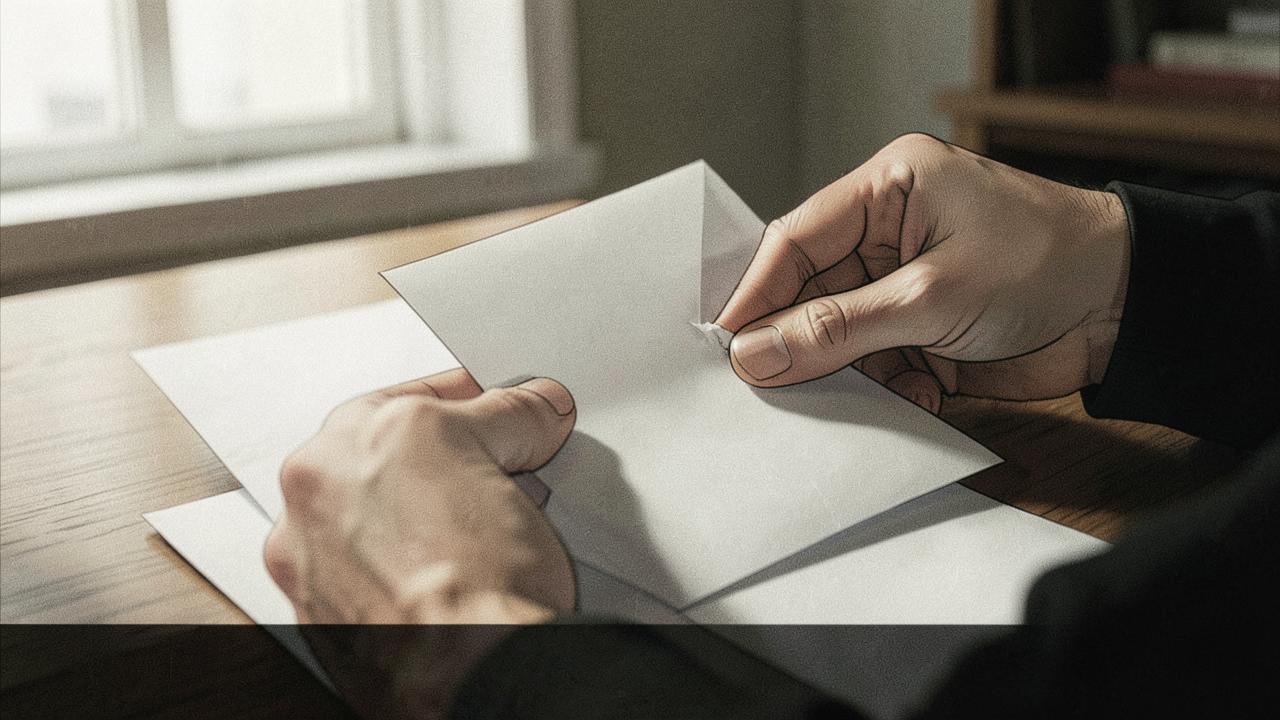
One tight frame. Ask what is missing, and what you are doing with the gap.
- 01
What's in
Hands, paper, a table edge and a slab of window light. Four elements. That is a very small shot to hang a moment on, and the smallness is the point.
- 02
What's out
The face. The room. Whether anyone else is present. Every one of those absences is a question the audience now has to answer themselves.
- 03
What the exclusion buys
Without a face you cannot check how she feels, so you read the hands harder — the grip, the hesitation before the tear. Attention is transferred to the gesture by force.
- 04
What it costs
You lose the ability to place this in a story. Held for too long, or used too often, this frame becomes stylish and vague. Exclusion is a loan against later information.
- 05
What a beginner would do
Widen 'so people can see what's happening' — and hand the audience a face to read, which quietly excuses them from reading anything else.
Frame Lab
Visual mission
Find four frames where something important is deliberately kept out of shot.
Name the excluded thing, and name what the audience does with the gap. 'Mysterious' is not an answer.
FILMCRAFT stores your observations and source links — never other people's images.
Try It
One Edge Away
20 minutesShoot one still where the most important thing in the moment is just outside the frame — and the frame still tells you what it is.
Exactly 2 photographs.
Constraints
- Phone only, no cropping afterward — decide with your feet
- The excluded thing must be identifiable from what remains
- No text or captions in the image
- Same object, same position
- Change the crop or orientation only — no filters
Deliverable
One still, plus a sentence naming what you excluded and why.
Make It
Three Refusals
70 minutesTell a small story in exactly three ordered stills where each frame withholds something different, and the third gives exactly one thing back. The viewer should be able to describe the event without ever seeing it whole.
Exactly 3 photographs.
Constraints
- Exactly three ordered frames
- Never show the whole space in any frame
- One thing, and only one, is revealed in the third frame
- No captions, no on-screen text
- Context, emphasis, deliberate withholding
- Three alternatives, not a chronological scene
Deliverable
Three ordered stills, plus a line per frame naming what is out of shot.
AI Lab
The traditional workflow
You learn exclusion by shooting too wide, hating it, and walking closer until the shot starts refusing things.
What AI changes
Image models are trained to fill frames. Ask for a tight partial view and you will often get a tidy, complete, well-explained composition anyway — the model's instinct is to include. That instinct is exactly the one this lesson is trying to break in you.
Try it
Ask an image model for your Try It frame, describing the exclusion explicitly ('the face is out of frame'). Generate three. Count how many quietly put the face back in.
Compare
Name the difference between a frame that excludes and a frame that is simply cropped badly. Your own photograph probably answers this better than any of the three.
Ethics check
Do not use generated imagery to fake documentary moments — a frame that hides its subject is easy to pass off as real. Label planning images as planning images.
Sign in to sketch reference frames for this lesson.
- bookNotes on the CinematographAphoristic and extreme. The clearest argument for showing less.
- bookThe Visual StoryUse the chapter on space: the edge of frame as a controllable variable.
Reflect
Go Deeper
film
A Man Escaped
Robert Bresson · 1956
Watch twenty minutes and list every time a face is withheld.
interview
Céline Sciamma on the gaze and withholding
Various
On making the act of looking — and not looking — the subject of the film.