01.01.01
What Is a Shot?
A shot is a decision with a duration.
- Composition
- Camera Fundamentals
- Storytelling
What the Instructor can readYou make and play the recording yourself. The Instructor reads the written review you hand in — it has not heard or watched your work. This lesson's feedback rubric is new and has not been reviewed by an instructor yet.
The Idea
A shot is not a piece of footage. It is a sentence somebody chose to say.
Most people think a shot is whatever the camera recorded between pressing record and pressing stop. That is technically true and completely useless. The useful definition is smaller: a shot is one continuous view of something, held from one position, for as long as someone decided to hold it.
Inside that decision are four smaller ones. Where the camera is. How far it is from the subject. What height it sits at. And how long it stays. Change any one of them and you have changed what the audience believes, before a word is spoken.
This is the lesson everything else in FILMCRAFT sits on. Composition, cutting, point of view and genre are all arguments about these four choices. So for now: stop asking whether a shot looks good. Ask what it claims.
Watch
Watch the scene, not the film. Ten minutes is enough — you're studying a decision.
Jeanne Dielman, 23 quai du Commerce, 1080 Bruxelles
Chantal Akerman · 1975
The kitchen, filmed from the same fixed position each time
The same view returns again and again, unmoved. Duration becomes the subject: you start noticing the routine because the shot refuses to help you.
Do the Right Thing
Spike Lee · 1989
The direct-address insult montage
Same distance, same height, different faces. Because the shot design repeats exactly, the differences between the people land harder.
The Florida Project
Sean Baker · 2017
The motel walkways, shot at child height
Camera height alone decides whose world this is. Adults arrive into the frame from above, like weather.
Break It Down
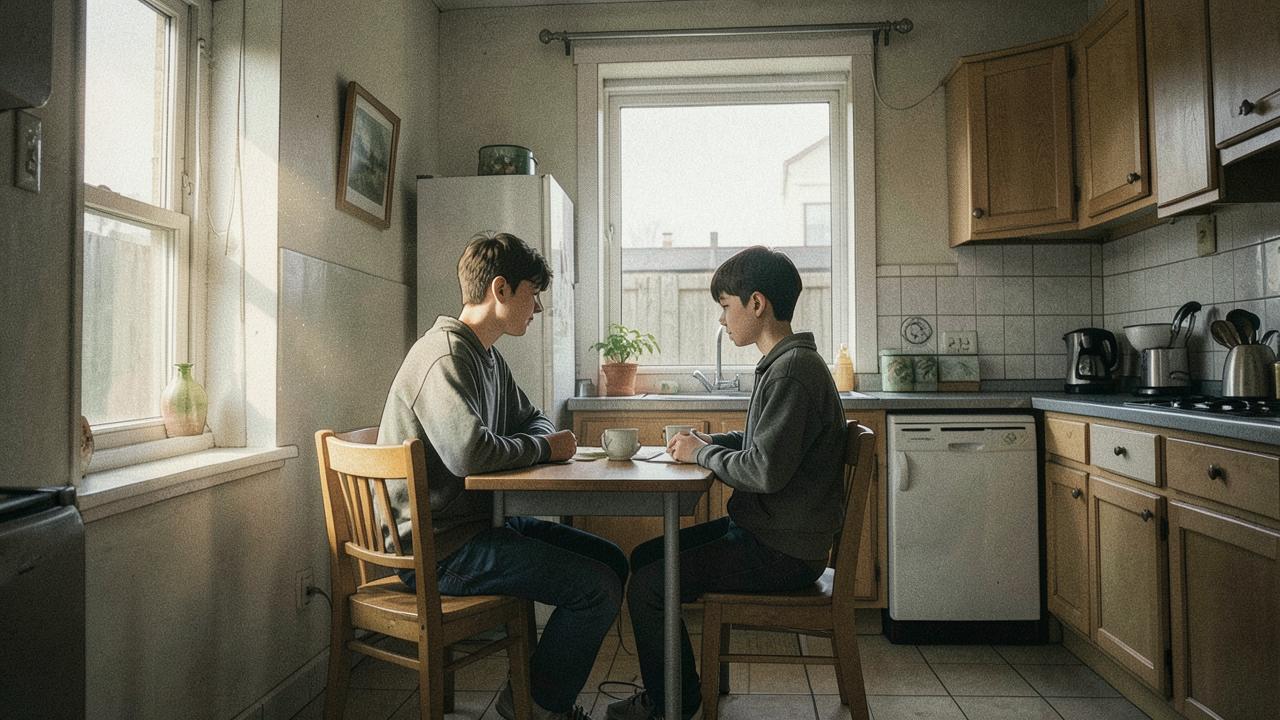
One frame, four decisions. Don't describe the story — name the choices, then ask what each one costs and buys.
- 01
Where the camera is
Across the room, outside the conversation, with the doorway wall in shot. The viewer is placed as somebody who walked in, not somebody at the table.
- 02
Distance
Far enough that both bodies and the whole room are readable. You get posture and furniture instead of expression — the shot chose situation over feeling.
- 03
Height
Roughly seated height. Nobody is looked down on. Had the camera stood up, the two of them would have read as smaller and more supervised.
- 04
Duration (the part a still can't show)
Held for two seconds this is an establishing shot. Held for twenty it becomes a statement about how little is being said. Same frame, different claim.
- 05
What a beginner would do
Cut straight to a close-up of whoever is talking — buying clarity, and spending the entire room, the distance between them and the silence that the wide is carrying.
Frame Lab
Visual mission
Find four frames and name the position, distance, height and likely duration of each.
Pick frames from four different films, and force yourself to guess the duration. Being wrong is useful.
FILMCRAFT stores your observations and source links — never other people's images.
Try It
Same Subject, Two Claims
25 minutesPhotograph one ordinary subject twice. Keep the subject, the location and the light identical. Change the camera position, the distance or the height so the two frames say different things about it. Submit both in the order they should be read.
Exactly 2 frames.
Constraints
- Phone only, no cropping, no filters
- Same subject, same location, same light
- Change camera position, distance or height — not the subject
- One continuous 10–15 second shot, camera still
- Keep the video on your own device
Deliverable
Two ordered stills, plus one line naming what changed and what that changed.
Make It
The Doorway Rule
75 minutesShoot three ordered stills of the same small event — someone arriving somewhere — from three deliberately different places: one from outside the space, one from inside it, one at the subject's own height and distance. The event stays the same; your relationship to it does not.
Exactly 3 frames.
Constraints
- Same event, same subject, same location
- One frame from outside, one from inside, one at the subject's own height
- No cropping — move your body to change the frame
- Two versions of one action, 15–25 seconds each
- Change only when recording starts and stops
Deliverable
Three ordered stills, plus a line per frame on where the camera put the viewer.
AI Lab
The traditional workflow
You learn shot design by shooting the same thing a hundred times and noticing what changed — and by stealing positions from films you rewatch with the sound off.
What AI changes
An image model will happily produce 'a wide shot of a kitchen' and it will look like one. What it cannot do is know why you are standing in the doorway rather than at the table, because that reason lives in a story it has not read.
Try it
Describe your Try It frame to an image model in camera terms only — position, distance, height. Generate it. Then compare its version with your photograph.
Compare
The model usually gives you the most average version of your description. Name one thing in your real frame that the generated one has no idea about: a chair pulled out, a specific window, the exact gap between two people.
Ethics check
Generated frames are planning material. They never count as your shot, and you never describe one as a photograph you took.
Sign in to sketch reference frames for this lesson.
- bookFilm Art: An IntroductionThe standard account of shot, framing and duration. Read the framing chapter only.
- ai-toolText-to-image previsualization (category, not product)Useful for blocking roughs. Judge it on control, not realism.reviewed 2026-09-13
Reflect
Go Deeper
film
Jeanne Dielman, 23 quai du Commerce, 1080 Bruxelles
Chantal Akerman · 1975
The most extreme argument ever made for duration as meaning. Watch twenty minutes.
book
Grammar of the Shot
Christopher J. Bowen
Plain, practical vocabulary for distance, height and angle.